
Prosperi-Qi
Build Prosperity with Feng Shui
A business is a living system; it expresses itself through the naturally arising cycle of the five elements.
Fundamental principles of feng shui, the five elements, yin and yang, and flow of qi, encourage a fresh perspective on how to attract and retain customers. Recommendations provide both introspection and pragmatism.

A commercial feng shui consultation offers an inquiry into whether the space is supporting the physical and mental wellbeing of the people upholding the business. It encourages the question, what is profit without health? No volume of sales can save the compounding effect of burnout, stress and disharmony between people. The result of reducing friction in the environment is the natural contentment of both the workforce and clients alike, increasing the success of the business.
Industries typically assessed:
Cafe or Restaurant
Hotel
Retail
Offices
Real Estate
Common problems that feng shui offers a solution for:
Lack of sales
Difficulties in communication
Inefficiency
Difficulties in staffing
Difficult client relationships
Disorganisation
Consistent obstacles
Recommendations may be based around furniture layout, door direction, elemental colour theory, qi patterns and symbolic placement of items, depending on what the situation calls for.

Feng shui has been applied to commercial and civic spaces in the East for as long as there has been settlement. Historically, certain lineages used it as a geomantic tool and, such was its efficacy, it was reserved solely for dynastic rulers, elite merchants, and religious institutions. Nowadays, many large companies are known to have used feng shui in their designs. The vast majority of landmarks in Hong Kong have incorporated fundamental principles. A master is known to have been consulted on the masterplan of Hong Kong Disneyland and to have worked closely with executives during construction. Additionally, the iconic HSBC building was designed after extensive consultation with feng shui experts. Outside of Asia, Richard Branson, business magnate, is noted to have used Flying Star Feng Shui for doors and water feature placement. Prominent entrepreneur and human rights activist, Anita Roddick, has used feng shui in the design of The Body Shop. This shows feng shui to be a pragmatic step in the physical assembly of a business.
A commonly recognised aim of feng shui is the amassing of “wealth luck”.
It is effective because money is a thought form.
Feng shui engages intentionally with the intangible: qi, the source of thought and feeling, as it manifests in material reality.
The Relationship and Philosophy of Feng Shui and Commerce
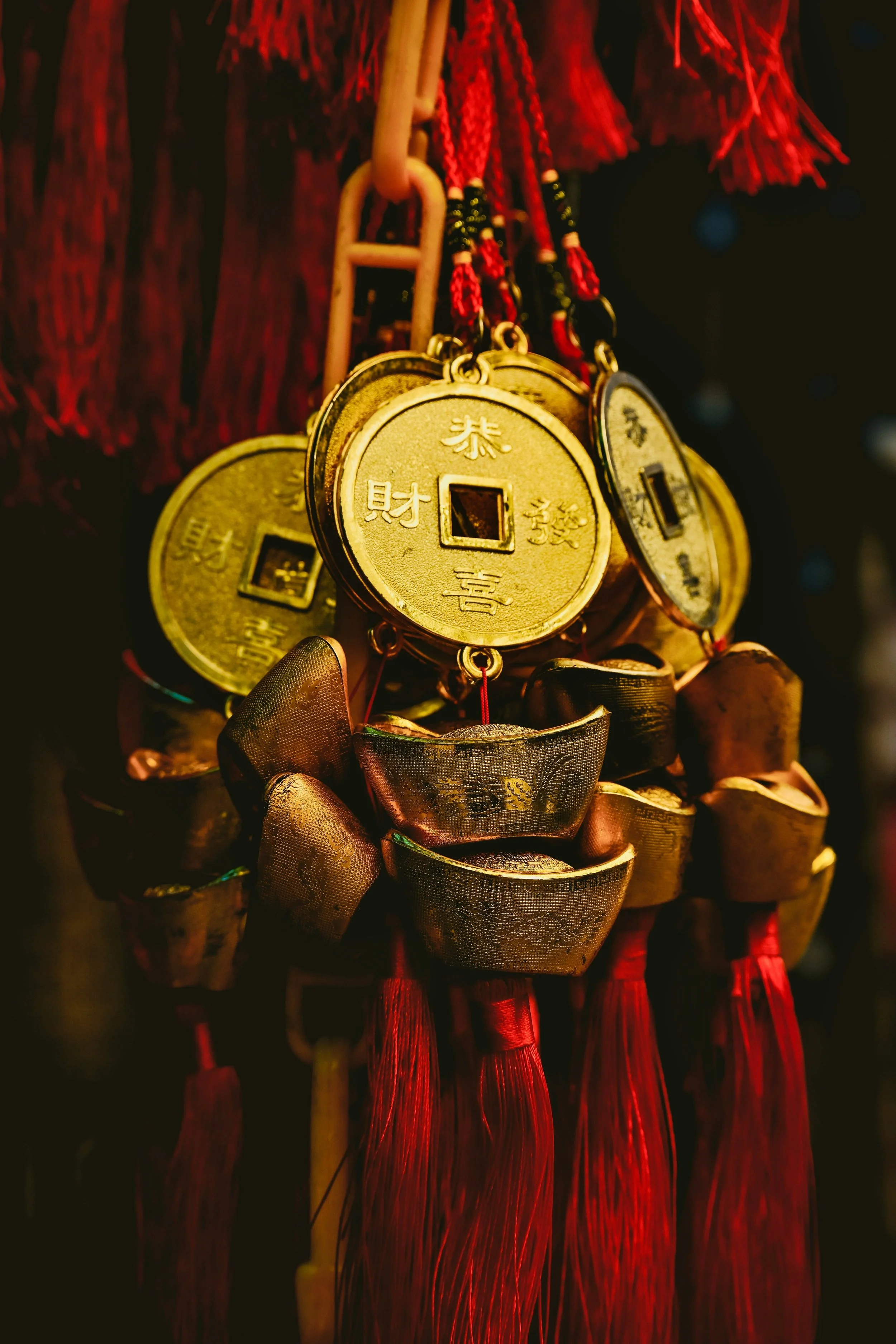
Money exists and functions because of collective agreement. It is a convertible value that governs much of human existence. It is therefore essential to recognise its pattern of motion; money flows exactly like water, across the globe, coming and going, in constant exchange. It is never still and, if it were, it would dissipate, which would still be a movement of redistribution. That is the shared behaviour of water and money, to stream in, to accumulate, to drain away, the source of material contentment and material anxiety. However, qi contains all elements, and so water, though potent, is not the only element to be harnessed. Metal is another key element as a physical representation of money, but also the character of metal, driven, ambitious, intense, is present in the pursuit of money. Earth represents wealth in land and property, fixed assets. Fire governs communication and sales. Wood is associated with innovation, growth and new ventures. A business is a living system, to be comprehended through the five elements. Feng shui in business looks at the expression of the elements contained within the physical space, and works to balance and support them so that the business may reach its full potential.
Most businesses begin with a genuine desire to offer something of value. It is often in the process of scaling that profit and purpose begin to pull in different directions, and the balance between generating wealth and adding genuine value to the world becomes harder to maintain. A business that pursues profit without offering real value is, from a feng shui perspective, accumulating debt of a different kind. A debt to humanity, if you will. The qi of a business that puts ethicality to one side may appear prosperous, but it deteriorates from the underbelly; inevitable stagnation with only a façade of success.